|
Flesh and
Machines: How Robots Will Change Us
***
Second tier
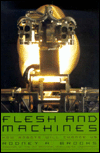
Flesh and Machines: How Robots Will Change Us is a 260
page non-fiction paperback book by Rodney A. Brooks published in 2002.
I was disappointed by Flesh and
Machines, Rodney Brooks’ rambling discourse on robotics. Unlike Ray
Kurzweil’s thought-provoking The Age of Spiritual Machines or even Hans
Moravec’s mind-bending Robot, Brooks seems to have no purpose in this
book, except to write one. The material is familiar and has been
covered better elsewhere.
Not that it wasn’t interesting in
spots. Once you get past his drawn-out autobiography, Brooks provides a
good overview of the problems researchers face trying to provide robots
with the capabilities humans find second-nature. Vision is a good
example; while computer vision is capable of detecting and recognizing
human faces from the front, it falls down when confronted by side views
or when people wear a hat, shave, even as they age.
Brooks is also interesting when he
discusses whether humans are special or just a biomolecular machine. As
you might expect, he sees us as machines interacting with the objects of
the world in accordance with physics, but he comes at it in a gentle,
considerate manner. Eventually, he asserts, mankind will accept robots
as emotional machines. Much as we have begun to overcome racial and
gender discrimination, we will begin to accept our robots, both
emotionally and legally.
Flesh and Machines is a cut below
Kurzweil’s and Moravec’s works so start with one of these. If you enjoy
the subject, pick up Flesh and Machines for a pleasant weekend read.
Enough:Staying
Human in an Engineered Age
****
not Enough
analysis
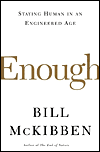
Enough: Staying Human
in an Engineered Age is a 271 page
non-fiction hardcover book by Bill McKibben published
in 2003.
Well, Bill McKibben is probably not
going to join the Ayn Rand workgroup. In this little-noticed but
important book, McKibben discusses the potential dark side of advanced
technologies such as genetic engineering, artificial intelligence,
robotics and nanotechnology. As opposed to some critics, he
concentrates not on the physical danger (e.g. robots becoming smarter
than us and taking over), but the threat to our humanness and freedom.
For example, in the coming years
parents may be able to increase the intelligence of their children
through germline enhancements. This choice, McKibben asserts, actually
reduces choice because all parents will be forced to make these
enhancements or have less intelligent children. This illustrates the
faulty logic that permeates his thinking. Parents will make this choice
– assuming the germline engineering is safe – because it results in a
benefit for their child. Isn’t that what parents are supposed to do?
If McKibben had his way, the government would eliminate this choice.
Following his convoluted logic, the elimination of choice actually
enhances choice.
Although McKibben confuses his
passion with logic, he does raise important issues. These technologies
have significant risks and benefits; it’s critical to have a thorough
debate now, because they are emerging so rapidly. Properly managed, we
can utilize them safely, even if we bumble from time to time.
I recommend this book, even if you
are on the other side of this issue. McKibben provides a good overview
of the technologies and then explains his concerns. You may disagree,
but his ideas get the juices going and make you think.
|