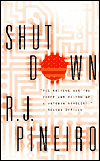
Shutdown is a
367 page paperback thriller book by RJ Pineiro published May, 2000.
R.J.
Pineiro writes a good suspense thriller and Shutdown is no
exception. A series of computer chip failures, leading to disastrous
computer shutdowns, begins to destroy public confidence in American
semiconductor plants. Erika Conklin, a hacker forced to work for the FBI
or go to jail, discovers that sabotage is causing the chips to fail.
With the help of special agent Brent McClaine, she discovers that the
failed chips were designed by traitors planted within the American
chipmakers by the Japanese government.
The plot
is fast moving and realistic, which we expect from the author, a chip
designer himself. The Erika Conklin characterization is thin but
acceptable. Brent McClaine is pretty much a stock character, however. A
good read for those of us who enjoy cyber-thrillers.
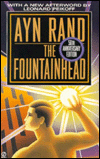
The Fountainhead
is a 687 page paperback by Ayn Rand first published in 1943.
My reviews generally focus on novels
and non-fiction works dealing with advanced technologies such as
artificial intelligence, genetics and the like rather than sixty year
old novels, but Rand’s ideas will become even more important – and
controversial -- in the coming decades. Although she has pushed
objectivism to an untenable extreme, she is still the most relevant and
important philosopher of our time and will remain so through the first
half of this century. Why? Because scientists will incorporate her
ideas into the new minds, both human and artificial, made possible by
these rapidly evolving technologies.
Ayn Rand is a great but flawed
philosopher. Her Howard Roark is one the most admirable and terrifying
characters to appear in any novel: a man of rigid, absolute principles;
of talent and determination; and of intellect and emotion. Also a man
who will stop at nothing, even violence, to gain his objectives; who
cares not a whit about the needs of others, even his paying clients; who
regards virtually all of humanity as parasites, living off the abilities
of men such as himself. Roark could be a great man; he could also be a
monster. These strengths will be attractive to many, leading science to
develop methods to enhance our machines and our genes. The latter will
be particularly attractive: who wouldn’t want these characteristics for
your child? The genetic inheritance of Howard Roark will be engineered
into our genes, but which ones? And where would such men take us?
The Fountainhead is a great
read as fiction, and Rand challenges us with her ideas. Rather than
fading into the background, such powerful ideas become more important as
time moves on.
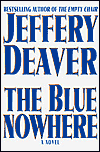
The Blue Nowhere is a
505 page paperback thriller book by Jeffery Deaver published February, 2002.
This is Jeffery Deaver’s first
venture into a cyberthriller and he does a pretty good job. The
strength of the novel is its plot: a no-holds-barred contest between two
hackers. Wyatt Gillette is doing time for a few minor computer crimes
when he is offered a temporary reprieve if he helps the state police
track down a murderous cracker called Phate. The plot takes one turn
after another, building suspense as Phate searches for new victims and
Gillette tries to stop him. Why is Phate committing these murders? Who
is his partner? Who’s the traitor within the police? Is Gillette
really a good guy? Plenty of mystery and suspense to keep you turning
the pages.
Although the plot is terrific, the
story has a couple of weak points. Deaver is not a computer pro and it
shows. Although many of the inaccuracies are minor – only a technically
sophisticated person would notice – some of them were really ridiculous
(Gillette’s fingertips are so strong from fingertip pushups that they
crush keyboards during coding sessions).
Another problem is that Phate turns
out to be a stock character – I won’t give away the details, but you
could probably put together a description without reading the novel.
It’s too bad because he starts out as an interesting, mysterious
adversary. Still, The Blue Nowhere is a good thriller, well worth
reading.